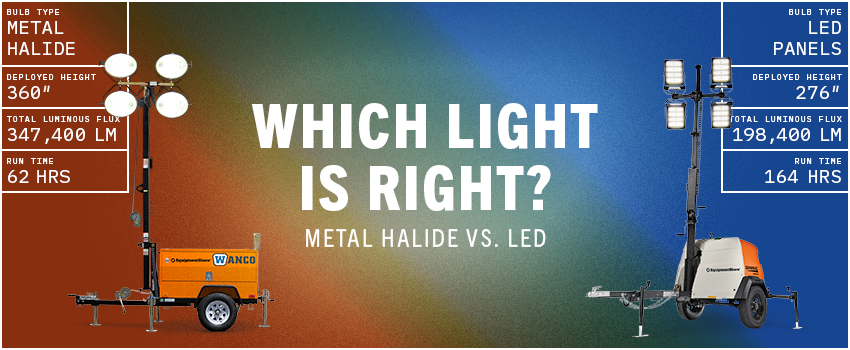
TLDR: Both LED and Metal Halide light towers have their pros and cons, this article breaks down the major differences by comparing performance data as well as technical specs to see which is the better fit for your jobsite.
Spec |
Metal Halide |
LED |
Warm-up time |
A few minutes to full brightness |
A few minutes to full brightness |
Restrike after power loss |
Requires cool-down period |
Instant restart |
Avg. fuel burn (towable unit) |
1.04 gal/hour |
1.03 gal/hour |
Avg. purchase price |
~$7,108 |
~$9,642 |
Value retention |
42% |
81% |
Best suited for |
Open sites needing max brightness |
Indoor, enclosed, or noise-sensitive sites |
Daylight starts disappearing fast this time of year. What was a 6 a.m sunrise in July slides later every week. By the time fall and winter set in, plenty of crews are starting and finishing their shifts in the dark. That shift moves light towers from a piece of equipment you grab occasionally to one you’re running every day, which makes this a great time to think about which light source can do the job for you.
Metal halide and LED are the two dominant light sources on the market today, and both are common on jobsites for good reason. EquipmentShare's own rental fleet includes both, from a 6kW metal halide towable light plant to LED options including a cordless light tower, so this isn't a hypothetical choice. This guide covers how each lamp type works, how they compare on brightness, runtime, and durability, and which one makes more sense as your nights get longer. Along the way, we'll also pull in performance data from EquipmentShare's own rental fleet to see how the two technologies actually hold up in the field, not just on paper.
How Do LED and Metal Halide Light Towers Work?
Metal halide is a gas-discharge technology, the same family as the high-intensity lights you'll find over a ballfield or in a warehouse. An electrical arc excites gas inside a sealed bulb, and that arc needs a warm-up period, often a few minutes, before it reaches full brightness. If you switch it off, it needs to cool down before it can be struck again. That's not a flaw so much as a characteristic of how this technology works, but it's worth knowing if your crew is used to flipping a switch and getting instant bright light.
LED is a solid-state technology with no gas, no arc, and no warm-up cycle. It reaches full brightness the moment power hits it, and it comes back on just as fast if it's switched off. That difference sounds small on paper, but on a jobsite where lights get toggled on and off throughout a shift, or where a generator hiccups and needs a restart, it's a real practical distinction. It's also the root cause of most of the other differences covered below, since a lot of what separates these two technologies traces back to how each one physically produces light.
Brightness, Coverage, and Color Quality for LED vs Metal Halide
Metal halide's traditional strength is raw output. A metal halide fixture puts out very high lumen output suited to lighting a large, open area from a single tower, and it typically has a warmer, slightly yellow-toned quality to the light.
Modern LED fixtures have closed most of that gap. For a given wattage, today's LED towers often match or exceed metal halide's brightness output, typically with a whiter, more even light that holds its color better as the fixture ages instead of yellowing or dimming unevenly over time. Beam spread and coverage pattern still vary quite a bit by specific fixture design in both technologies, so treat this as a general tendency rather than a fixed rule, and check the actual lumen and coverage specs on the product you're considering rather than assuming based on lamp type alone.
Runtime, Power Consumption, and Efficiency for LED and Metal Halide Light Plants
On paper, LED's lower power draw for a given lumen output should translate directly into lower fuel burn on a towable unit, since LED fixtures convert a much higher share of input power into usable light rather than losing it as heat. However, data tells a more nuanced story. Across active towable light plants, average fuel burn comes out nearly identical between the two technologies, about 1.03 gallons per hour for LED units and 1.04 gallons per hour for metal halide. The reason is that on a towable light plant, it's the diesel generator, not the light head, that accounts for most of the fuel burned. Mast raise and lower, controls, and generator overhead losses outweigh the marginal difference between an LED and a metal halide bulb's power draw.
Where the numbers do diverge is in demand, not efficiency. LED units across the fleet see meaningfully higher utilization, sitting in active use on roughly 42.5% of available days compared to 29.3% for metal halide. That higher demand is also why LED units account for more total fuel burned and more emissions per day fleet-wide (an average of 45.8 kg of CO2 per day versus 27.6 kg for metal halide), not because any individual LED unit runs less cleanly, but because LED units are simply working more days overall. If you're comparing two units side by side for a single job, expect a similar hourly fuel cost either way. If you're looking at fleet-wide usage, expect LED units to rack up more total runtime largely because more crews are choosing to run them.
Durability and Maintenance of LED and Metal Halide Lights
Metal halide bulbs have a finite rated life, and their output gradually fades before the bulb fails outright, which means a fixture that's been in service a while may be dimmer than it looks like it should be. The bulbs are also sensitive to vibration or impact while they're hot and running, which is worth keeping in mind on a jobsite where other equipment is moving around the light tower.
LED fixtures are typically rated for tens of thousands of hours with minimal light degradation across that span, and the solid-state construction holds up noticeably better against vibration and rough handling. In practice, that means metal halide bulbs are a recurring replacement item over a fixture's life, while an LED fixture is closer to an install-and-forget component. Rated hours vary by manufacturer and model, so check the specific fixture's documentation rather than assuming a universal number.
That possible durability gap shows up clearly in EquipmentShare's own fleet reliability numbers. At any given time, metal halide light towers are down and unavailable for rent about 30.7% of the time, more than double the 14.3% down rate for LED units. Metal halide units also need more repair visits, averaging 6.8 service work orders per unit per year compared to 5.2 for LED, and ballast and bulb failures are a recurring driver of that gap. Some of the difference reflects fleet age as much as bulb technology on its own: the average metal halide unit in the fleet is a 2019 model with roughly 5,800 hours on it, while the average LED unit is a 2024 model with under 1,900 hours. Older, harder-run equipment tends to fail more regardless of light source, so part of LED's reliability edge here is also a reflection of running newer machines, not the lamp technology alone.
LED or Metal Halide: Which Should You Choose This Fall and Winter?
Start with total nightly runtime. As nights get longer heading into fall and winter, LED's lower power draw compounds into a bigger fuel or power-cost advantage than it delivers during short summer nights, simply because there are more hours for that efficiency gap to add up.
Noise and emissions matter too, and they point in different directions depending on the site. An LED electric unit runs quieter and without combustion exhaust, which is the better fit for indoor work, enclosed spaces, or noise-sensitive sites near residential areas. A metal halide towable unit running off a diesel generator is a better match for open sites where maximum concentrated brightness over a large area is the priority.
Your budget is worth weighing from both directions, and the fleet numbers add some texture here too. LED units carry a higher average purchase price, around $9,642 compared to roughly $7,108 for metal halide, but LED units also hold onto far more of that value over time. LED units in the fleet retain about 81% of their original value on average, compared to just 42% for metal halide. Combined with LED's higher utilization and lower repair frequency, that value retention is a real factor in a total cost of ownership comparison, not just a sticker price. EquipmentShare's rental lineup, which includes both the metal halide towable unit and LED electric and cordless options, is a good example of how these aren't competing for the same job so much as covering different ones. The right call still depends on the site, not just on picking a universal winner.
Fall's shrinking daylight is a good time to reassess which light tower type actually fits your fleet's upcoming workload, before winter brings the shortest, darkest days of the year. Metal halide still makes sense where raw, concentrated brightness over an open area matters most. LED makes sense where efficiency, quiet operation, and low maintenance matter more, especially as nightly runtimes keep growing, and it's worth noting that across EquipmentShare's own fleet, LED is the newer, higher-utilization, more reliable, and better value-retaining asset overall, while the metal halide fleet is aging and trending toward retirement as those units wear out.
When you've made your call, EquipmentShare Shop carries lamps, luminaires, ballasts, and other electrical components for both metal halide and LED light towers, so replacement parts are on hand as your fleet leans on them more.This article is intended as general informational content. Lumen output, wattage, runtime, and bulb life vary by specific model and manufacturer. Consult product documentation and a qualified technician for guidance specific to your equipment